
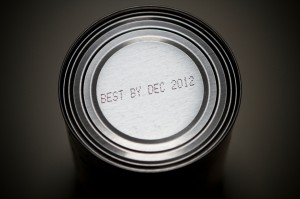
This past September, 22-year-old university student Solveiga Pakštaité won the James Dyson Award for a final class project. She invented a brand new take on expiry labels that has the potential to change the date system we’ve been using until now. Not only is this product unique because virtually anyone can touch it to find out if their food has expired, but it’s also much more accurate than a traditional printed expiry date. Not convinced? Continue reading to learn all about Bump Mark! A Multilayered Solution If you are currently enrolled in a food quality training program, you will definitely.. READ MORE »

Following somewhat shocking research that revealed Americans eat and drink one third of their calories away from home, the FDA (Food and Drug Administration) has put immense effort into passing a law that will require major restaurants to display calorie counts clearly on their menus. Vending machines, long-time providers of unhealthy snacks and beverages, will also be required to display calorie counts under the new law. The FDA hopes that as a result of the law, Americans will make healthier eating choices and restaurants will feel pressure to offer healthier meal options. The Road to Calorie Counts Today, two out.. READ MORE »

Taking a plane to visit grandparents in Florida, or a sibling living overseas can be a fun way to spend your holidays. However, be aware that travelling during the winter makes us particularly vulnerable to the flu. With so many people sick during the winter season, germs can collect quickly in enclosed areas like trains, buses or planes. So what’s your everyday traveller supposed to do to keep their immune system on lock-down while travelling, and avoid arriving sick at their destination? We’ve got everything you need to know about staying healthy while on the go. Bring Hand Sanitizer Even.. READ MORE »

Experts in food safety training believe that the HACCP certification first originated from WW2 artillery shell testing. Today, hazard analysis and critical control points (HACCP) is used as a preventative tool to ensure food safety, helping professionals anticipate risks along stages of the food chain including packaging and distribution. Workers in the retail food supply chain, such as manufacturers or packagers will often be required to obtain HACCP certification to ensure proper risk-assessment. This may include workers in the meat and seafood industries, and fascinatingly – even those who produce and package space food. Whether you’re planning to obtain your.. READ MORE »

The term “Mediterranean diet” was first coined in 1980 after an academic-lead investigation of cardiovascular death rates in different parts of the world. While the US and Finland held high rates of cardiovascular disease, regions in Greece and Southern Italy had very low rates. After surveying the lifestyles of these regions, it was determined that diet was the greatest factor contributing to improved life expectancy. The Mediterranean diet has since been found to reduce the risk of heart disease, diabetes, Alzheimer’s, and has also been successful for weight loss. What is a “Mediterranean” Diet? We hear the term on.. READ MORE »
In Canada alone, there are approximately 250 food recalls each year. Although some of these incidents are labelled as low risk, others have the potential to spread serious illnesses like E. coli, listeria and salmonella. As consumers, it’s important to stay informed about any food products that carry health risks—a fairly simple task given today’s excessive media coverage, accessible easily via TV, computers and cell phones. But did you ever wonder how an item gets recalled in the first place? Who identifies the safety threat? Who gets products removed from store shelves? Keep reading to find out everything you.. READ MORE »

As a restaurant chain existing since 1940 and serving 86 million customers every day, McDonald’s certainly has a reputation—both good and bad. In recent years, this reputation has begun to dwindle with the release of documentaries like “Supersize Me” posing serious questions about the health effects of the restaurant’s food. As our attitude (and education about) food evolves, McDonald’s must try even harder to win over customers who are far more likely to exchange burgers and fries for green beans and quinoa. Last year, the company saw a 1.5% dip in sales, following a 0.2% dip from the year before… READ MORE »

As the go-to caffeine buzz for college students and high schoolers, health officials have long been skeptical about the effects of energy drinks. With their lack of nutritional labelling, energy drinks are a huge concern for the health of young people. Packed with sugar, high caffeine levels, taurine (increases energy levels) and ginseng, energy drinks have long been claimed as a health product—something which is now changing. After several deaths related to the consumption of energy drinks, and many others who claim energy drink companies use false advertising, government regulatory affairs has stepped in to change the way energy drinks.. READ MORE »

Maybe you’re a culinary student who needs their food handler certificate in order to start a restaurant, or work as a chef. Perhaps you have a desire to work in food manufacturing, where you will manage how the food is brought from farms to dining tables. Receiving training in food safety and handling can open up several different career paths for you, some in typical food handling roles but others in inspection and quality assurance. If you’ve been wondering what types of jobs are available out there in food handling and safety, then look no further. Possible Careers Food is.. READ MORE »

Every year, around 4 million Canadians fall victim to food borne illness. Signs of sickness may set in right away – or take weeks to show themselves. And symptoms range from abdominal pain and vomiting, to disorientation, organ failure, and if untreated even death. With so much of our food undergoing extensive transport, processing, and handling, it makes sense that food safety training would be of the utmost concern to health officials, producers, and consumers. In 2006, Toronto city council passed a Food Handler by-law that makes it necessary for owner/operators of food establishments to have at least one supervisor.. READ MORE »