

In Summary: SOC Alert Triage
SOC alert triage is the process of reviewing security alerts to determine which ones require investigation, escalation, or response. Analysts examine factors such as the affected asset, user activity, event severity, indicators of compromise, and supporting log data. Effective triage helps security operations teams prioritize credible threats while reducing time spent on false positives and repetitive alerts.
Imagine starting your shift in a Security Operations Centre (SOC) and finding hundreds of alerts waiting for review. One flags repeated login failures. Another reports unusual network traffic. Several others may represent normal activity that simply triggered a detection rule.
Where do you start?
SOC alert triage helps cybersecurity teams answer that question. For students developing entry-level cybersecurity analyst skills, learning to distinguish potentially serious activity from routine noise is an important step toward understanding how real-world security monitoring works.
What Is SOC Alert Triage?
It is the process of reviewing incoming security alerts, gathering context, assessing potential risk, and deciding what should happen next.
Alerts can originate from tools monitoring endpoints, networks, applications, identities, cloud environments, and other systems. A security operations centre analyst does not automatically assume that every alert represents an attack. Instead, the analyst investigates whether the activity appears legitimate, suspicious, or malicious.
The Canadian Centre for Cyber Security notes that SIEM systems can collect and analyze information from multiple sources, correlate events, detect indicators of compromise, generate alerts, and help teams manage triage.
Students in our Applied Cybersecurity Engineer Diploma Program can benefit from understanding this workflow because detection is only useful when analysts know how to interpret what their tools are telling them.
Why Do Cybersecurity Teams Need to Prioritize Security Alerts?
Because analysts have limited time, while monitoring systems can generate large volumes of notifications. Not every event presents the same level of risk. A suspicious login involving a privileged administrator account, for example, may deserve faster attention than a low-risk event affecting a less critical system.
Effective security event prioritization considers context alongside technical severity. Analysts may consider the importance of the affected asset, the type of activity detected, available threat intelligence, potential business impact, and whether related events have occurred.
This is closely connected to cybersecurity risk assessment and threat prioritization. Good triage is not simply about working through alerts in the order they arrive. It is about directing attention where it may matter most.

Analysts use context from logs, endpoints, users, and networks to investigate suspicious activity.
How Do Analysts Determine Whether an Alert Is a Real Threat?
They investigate the surrounding evidence rather than relying on the alert alone. During a cybersecurity alert investigation, an analyst might check whether the activity matches normal user behaviour, whether an IP address has a suspicious reputation, whether unusual processes appeared on an endpoint, or whether several related alerts point toward the same activity.
The Cyber Centre’s Howler triage platform illustrates this distinction by categorizing anomalies according to whether activity is non-malicious, requires triage, or has been confirmed as malicious evidence. Its workflow also supports filtering known scenarios that repeatedly generate false positives.
When evidence indicates a credible incident, the analyst may escalate it according to established incident response playbooks and cybersecurity investigations.
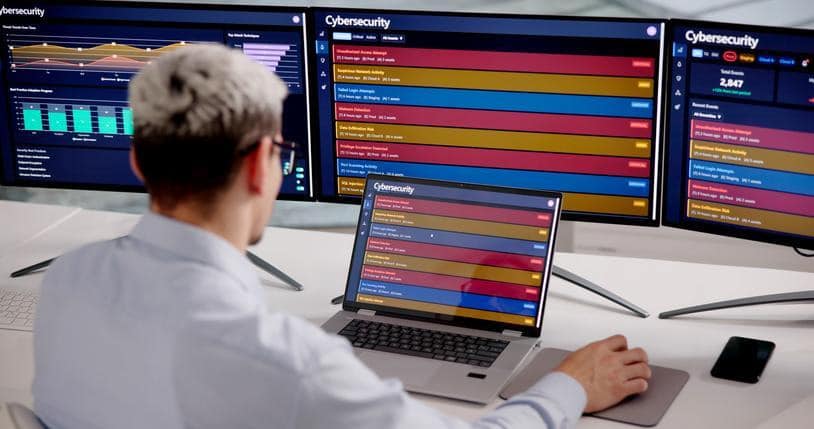
SIEM platforms help security teams collect and correlate events from multiple sources.
What Information Does a SOC Analyst Review During an Investigation?
The answer depends on the alert, but analysts often bring together information from several sources.
They may review:
- Timestamps and event sequences
- User and account activity
- Source and destination IP addresses
- Endpoint events
- Authentication records
- Network traffic
- Affected devices or applications
- Indicators of compromise
- Previous related alerts
Correlating this information can reveal a story that one alert cannot tell by itself. The Cyber Centre notes that SIEM platforms can correlate security events sharing common attributes and combine information from users, network devices, applications, endpoints, and cloud infrastructure.
This is why curiosity and analytical thinking are valuable alongside technical knowledge. Analysts need to ask not just, “What happened?” but also, “Does this behaviour make sense here?”

Effective prioritization helps analysts focus on alerts that pose the greatest risk.
What Is Alert Fatigue in Cybersecurity?
It occurs when analysts face so many alerts, particularly repetitive or low-value ones, that maintaining attention and identifying genuinely important events becomes more difficult.
Poorly configured monitoring systems can make the problem worse. The Cyber Centre warns that improperly implemented SIEM solutions may generate more false positives and unhelpful alerts, placing additional strain on cybersecurity teams.
Reducing unnecessary noise can involve refining detection rules, automating repetitive triage tasks, filtering known false-positive scenarios, and regularly reviewing monitoring configurations. The Cyber Centre similarly notes that improving detection efficiency and lowering false positives can help organizations avoid alert fatigue.
For future analysts, this highlights an important reality of SOC work: effective cybersecurity is not about reacting to everything. It is about investigating carefully, prioritizing intelligently, and knowing when the evidence justifies escalation.
Are you looking for a comprehensive Applied Cybersecurity Engineer Diploma Program?
Contact AAPS College for more information.
Key Takeaways
- SOC alert triage helps analysts decide which security events need investigation, escalation, or response.
- A security operations centre analyst considers context rather than assuming every alert represents an attack.
- Security event prioritization helps teams direct limited resources toward potentially higher-risk activity.
- Analysts may examine logs, user activity, endpoints, network traffic, indicators of compromise, and related alerts.
- False positives and excessive low-value alerts can contribute to alert fatigue.
- Strong entry-level cybersecurity analyst skills include analytical thinking, attention to detail, technical investigation, and appropriate escalation.
FAQ
What is SOC alert triage?
SOC alert triage is the process of reviewing security alerts, gathering relevant context, assessing their potential risk, and determining whether they should be dismissed, investigated further, or escalated.
Why do cybersecurity teams need to prioritize security alerts?
Security teams may receive more alerts than analysts can investigate simultaneously. Prioritization helps them focus first on activity with potentially greater security or business impact.
How do analysts determine whether an alert is a real threat?
Analysts examine supporting evidence, such as logs, user behaviour, network activity, endpoint events, threat intelligence, and related alerts, before deciding whether activity appears benign or malicious.
What information does a SOC analyst review during an investigation?
Depending on the alert, analysts may review authentication records, IP addresses, timestamps, network traffic, endpoint activity, affected assets, user behaviour, and indicators of compromise.
What is alert fatigue in cybersecurity?
Alert fatigue occurs when excessive or repetitive security notifications make it harder for analysts to maintain focus and identify important threats efficiently.