
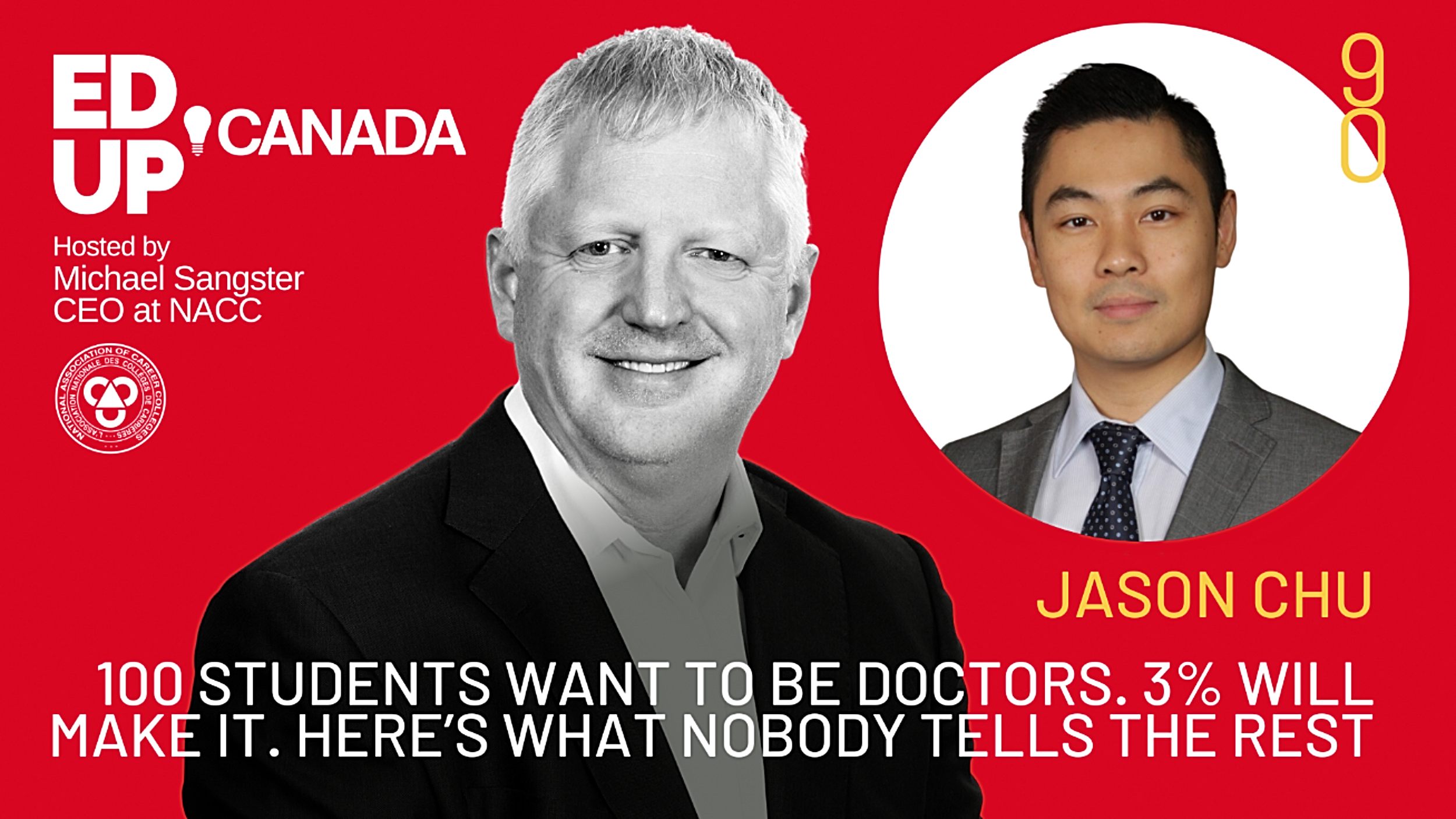
Career Education in Canada in Brief
- The EdUp Canada conversation focused on a question many science graduates quietly face: what happens when the traditional path into medicine, pharmacy, dentistry, or research does not unfold as planned?
- Jason Chu explained how AAPS College works with learners who often already have strong academic backgrounds, including science degrees, graduate credentials, and international healthcare experience.
- The discussion explored how career-focused education can help learners understand regulated industries, employer expectations, practical workflows, and the steps needed to move from academic knowledge into career-ready confidence.
- A key theme was that student success should not be measured only by graduation, but by whether learners can use their education to build meaningful careers.
What happens when students spend years earning science degrees, only to discover that the career path they imagined is far more competitive than expected? That question shaped Jason Chu’s recent conversation on the EdUp Canada podcast, regarding career education in Canada, hosted by the National Association of Career Colleges (NACC).
NACC is the national voice for Canada’s regulated career college sector, representing institutions that focus on practical, career-focused education. In this episode, Jason Chu, Director of Operations at AAPS College of Health Sciences and Technology, joined the conversation to discuss a reality many science graduates face: strong academic credentials do not always translate directly into employment.
Rather than presenting career colleges as a shortcut, the podcast explored them as a bridge. Jason spoke about students with bachelor’s degrees, master’s degrees, PhDs, and international healthcare experience who need practical, industry-aligned training to connect what they already know with what employers expect in regulated sectors.
Bridging the Gap Between Education and Employment
During the podcast, Jason described the gap many science graduates encounter after completing university: they may understand the theory, but still need exposure to the regulations, quality systems, documentation practices, and workflows used in highly regulated sectors such as pharmaceuticals, clinical research, and healthcare.
This is where AAPS enters the conversation. The college’s role is not presented as replacing academic education, but as helping learners build on it with more practical, employment-focused preparation. For students trying to move from broad scientific knowledge into a defined industry role, that kind of bridge can make the next step feel clearer.
Students enrolled in AAPS College programs learn the practical knowledge employers expect while preparing for specific industry roles. Prospects can also explore AAPS student testimonials to see how graduates have successfully transitioned into careers across Canada’s life sciences industry.

The podcast conversation explores how career-focused education can help learners connect academic experience with employment opportunities.
Expanding Opportunities for Science Graduates
One of the most memorable parts of the podcast was Jason’s discussion of students who begin university with a very specific goal: becoming a doctor, dentist, or pharmacist.
The episode title captures that tension directly: many students may start with the same dream, but only a small percentage ultimately move into those highly competitive professional pathways. Jason’s point was not that those students have failed. Instead, he reframed the conversation around the many career options that can still use their science background in meaningful ways.
Today’s science graduates’ careers in Canada extend far beyond traditional clinical professions. Pharmaceutical quality assurance, regulatory affairs, pharmacovigilance, clinical research, medical affairs, and food safety are just a few examples of careers where scientific knowledge remains highly valuable.
Career-focused education helps students discover these opportunities while developing the specialized skills employers seek.
Supporting Internationally Educated Professionals
The conversation also turned to internationally educated professionals in Canada, many of whom arrive with years of experience as physicians, pharmacists, researchers, or healthcare professionals.
Jason described the challenge many newcomers face: they may have deep subject knowledge and professional experience, but still need to understand Canadian regulations, workplace expectations, and industry pathways before they can regain career momentum.
In this context, career-focused education can serve as a bridge rather than a reset. It can help internationally trained professionals translate previous experience into Canadian industry readiness without dismissing the value of what they have already achieved.

Many science graduates benefit from guidance that helps them translate academic knowledge into practical career options.
Career Services Begin Before Graduation
Jason also emphasized that career preparation should begin before graduation. In the podcast, this point came through clearly: students benefit from the career services at AAPS College, as they start thinking about resumes, interviews, employer expectations, and professional communication while they are still completing their training.
For AAPS, this reflects a broader view of career education. Technical training matters, but so does helping students understand how to present their experience, connect with employers, and prepare for the realities of entering a regulated workplace.

Practical training can help learners understand regulated industry expectations, documentation practices, and workplace workflows.
Career Education in Canada That Creates Opportunities
Perhaps the strongest takeaway from the interview is that education should not be viewed as an endpoint. It should become a foundation for meaningful work, continued growth, and lifelong learning.
Jason’s conversation with EdUp Canada shows why career education in Canada matters for learners who already have knowledge, ambition, and experience, but need a clearer route into employment. For science graduates, newcomers, and career changers, the next step is not always about starting over. Sometimes, it is about finding the right bridge between what they already know and where they want to go.
AAPS College is one example of how career-focused education and job-ready training in Canada can help learners connect academic and professional experience with regulated industry expectations. The larger message of the podcast is encouraging: with the right support, education can become more than a credential. It can become a path forward.
Are you interested in exploring career-focused AAPS College programs that help connect education with opportunity? Contact AAPS College for more information.
Contact us for more information.
Key Takeaways
- Career education in Canada is increasingly focused on helping learners connect academic knowledge with practical employment pathways.
- AAPS College supports science graduates’ careers in Canada by helping students build industry-specific skills for regulated fields such as pharmaceuticals, clinical research, healthcare, and food safety.
- Practical diploma programs can help internationally educated professionals in Canada build on their existing experience while learning Canadian workplace expectations and industry standards.
- Job-ready training in Canada helps students move beyond theory by developing practical skills, career confidence, and awareness of employer expectations.
- Jason Chu’s podcast conversation reinforces AAPS College’s focus on student success, industry-connected learning, and career preparation before graduation.
FAQ
How can career colleges help internationally educated professionals rebuild career momentum in Canada?
Career colleges help internationally educated professionals in Canada develop knowledge of Canadian regulations, workplace standards, and industry-specific skills while building on their previous education and experience.
Why do career services matter before graduation, not just after?
Beginning career preparation early allows students to improve their resumes, practice interviewing, build professional networks, and connect with employers while still completing their education, increasing their confidence and job readiness.
What does career education in Canada look like outside the traditional university path?
Career education in Canada often focuses on practical, industry-specific training that prepares students for particular occupations through shorter, employment-focused diploma programs and hands-on learning.
Why do some science graduates still struggle to find relevant jobs after completing advanced degrees?
Many graduates have strong academic knowledge but limited exposure to industry regulations, workplace practices, and employer expectations that organizations often require for entry-level roles.
What makes shorter, industry-aligned diploma programs attractive to career changers and newcomers?
Shorter diploma programs focus on practical skills, current industry practices, employer connections, and faster entry into the workforce, making them attractive options for many learners.